Music was Hazel’s passion.
But she also knew that it could stir the spirits of those around her, and she could share her passion through her performances. At a basic level, she enhanced the enjoyment of the audiences who watched the silent films she accompanied. But she would have argued that she made them truly understand the emotions the actors were feeling, the depths of the moments each ticket-holder was viewing, the excitement and the pathos of the entire show.
When she played sacred music at home, it was sometimes for her own enjoyment, but it was often to instruct her family or to make a point. When she played in church, because of the tremendous level of her skill, she hoped that it would elevate the sense of reverence the congregation felt. Hazel was an intensely faithful woman.
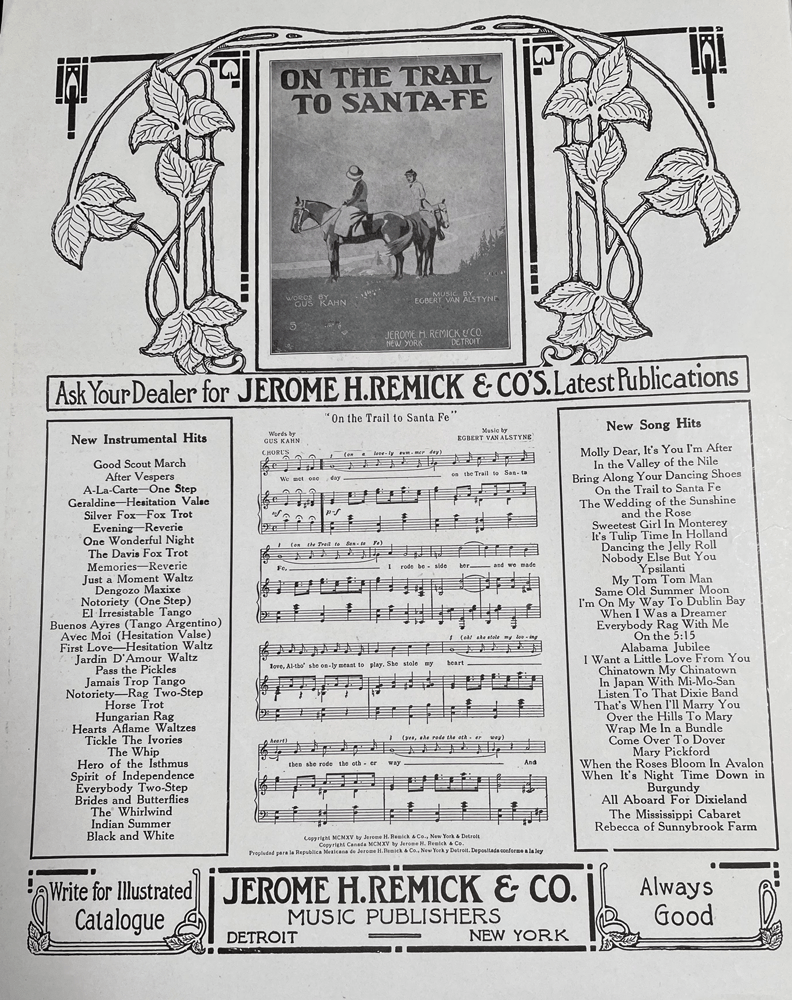
I am not sure whether she took part in musical events as a suffragist, but I imagine that she did. When I found the sheet music I have pictured here as I was rummaging through one of my favorite New England used bookstores, I was thrilled to purchase it. It is an old woman’s suffrage song written in the early part of twentieth century, when a new slogan set to music was more likely to become a topic of conversation than one published in a newspaper because it was carried on a sign and shouted in the streets.
Charlie always teased Hazel about her penchant for buying way too much sheet music, even after they had the gramophone and later, the radio. Of course, everybody wanted the most recent tunes, because that was how they entertained themselves. Many of them were also tied to the newest dances, like the “Silver Fox-Fox Trot”, “The Just a Moment Waltz”, “Notoriety (One-Step)”, “El Irresistible Tango”, “Horse Trot”, “Hungarian Rag”, “The Whip”, “The Whirlwind”, and “Dancing the Jelly Roll”.Others recalled famous places, like “In the Valley of the Nile”, “On the Trail to Santa Fe”, “It’s Tulip Time in Holland”, “I’m On My Way to Dublin Bay”, “Alabama Jubilee”, “When the Roses Bloom in Avalon”, “Come over to Dover”, “When It’s Nighttime down in Burgundy” . . . you get the picture.
Probably the best-loved and most-frequently recorded “place song” of the era, one that became a jazz standard, was “Chinatown, My Chinatown”. I remember Hazel playing that one, and it was published way back in 1910.
Incidentally, the tune pictured here is not great music. When I proudly showed my “find” to my daughter, she of course sat down at the piano to sing and play it. She didn’t get very far before she looked at me and said, “This guy’s a hack, Mum. It’s terrible.”
I was crushed. But then I realized that didn’t make it any less important to the whole story. I’d found a piece of history tucked away in a dusty corner of a used bookstore well off the beaten path in New Hampshire. Nobody bats a thousand. Just ask Charlie.
Click to view a larger image ~


 Inherited Treasures Series